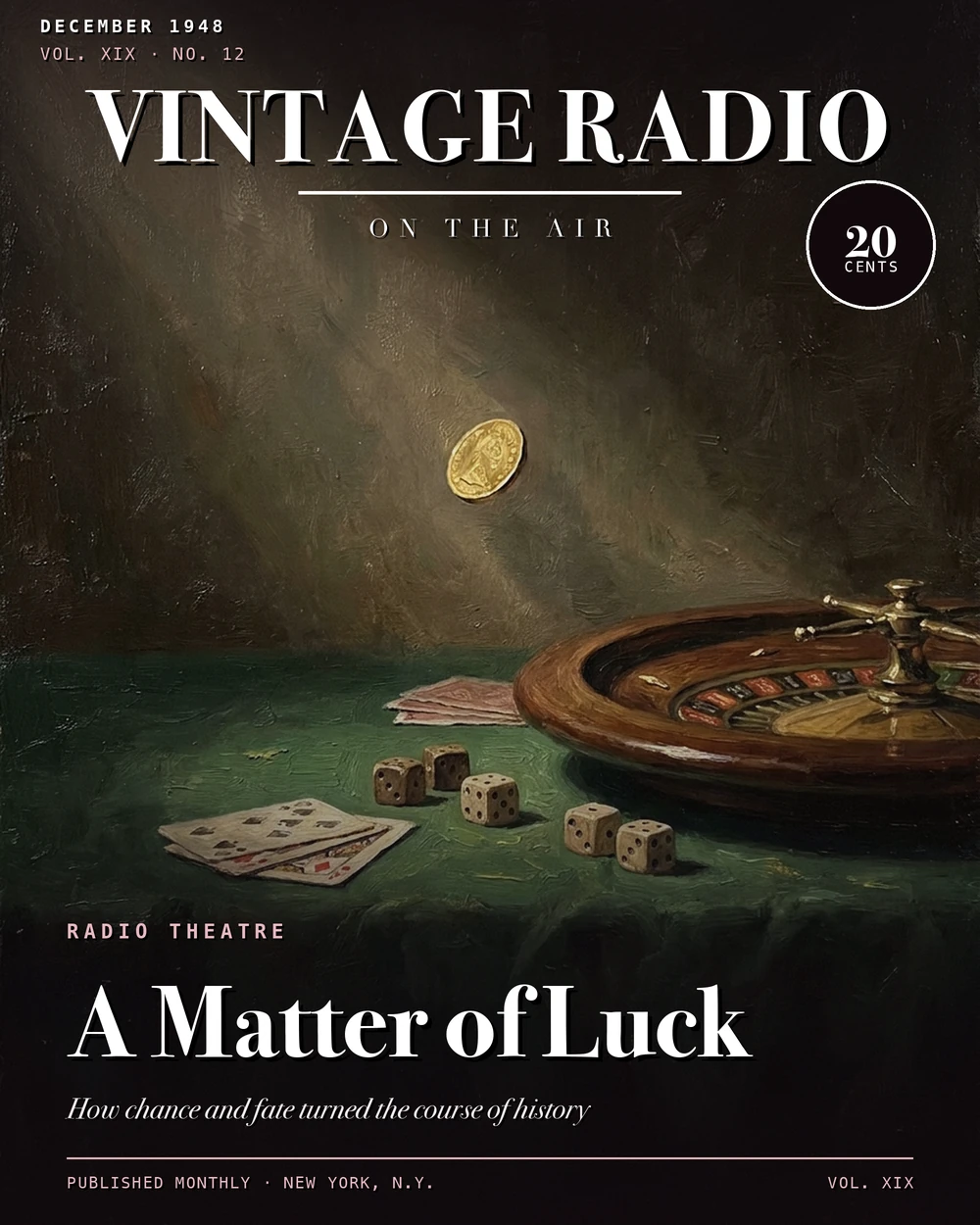
A Matter of Luck
The Idea Behind the Show
A Matter of Luck took a simple but genuinely interesting premise and ran with it: what role did chance play in the lives of the people who changed the world? Each of the eight episodes pairs two historical inventors or scientists and examines how fortunate circumstances, accidental discoveries, and lucky timing shaped their breakthroughs — while also asking how much credit belongs to sheer determination. The format of pairing two figures per episode gave the show a comparative quality, letting listeners weigh one inventor's story against another and draw their own conclusions about how much of history turns on luck versus hard work.
The show also turned the question back on the listener. Rather than simply celebrating its subjects as inevitable geniuses, A Matter of Luck treated their stories as case studies in serendipity — and implicitly asked whether the same forces might be at work in ordinary lives. That reflective angle gave the series a little more depth than a straightforward historical biography program.
The Episodes and Their Subjects
One episode puts Henri Becquerel alongside Edward Goodrich Acheson — a pairing that practically writes itself. Becquerel's 1896 discovery of radioactivity is one of the most-cited accidental discoveries in scientific history: overcast weather prevented his planned sunlight experiment, he set his photographic plates aside near uranium samples, and when he finally developed them, he found they had been fogged by radiation he hadn't known existed. Acheson's story runs parallel — he stumbled onto carborundum, or silicon carbide, while trying to synthesize a diamond substitute, and the material he accidentally created became commercially significant enough to earn him the Society of Chemical Industry's Perkin Medal in 1910 for "innovation in applied chemistry resulting in outstanding commercial development."
Another episode pairs Thomas Edison with Alessandro Volta — whose name appears in the episode records as "Alesandro Volta," likely a misspelling in the original production materials. The pairing links two central figures in the history of electricity, both associated with the interplay of experiment, persistence, and fortunate timing. What makes the Edison-Volta episode especially interesting in context is that Acheson, featured in a separate episode, had worked directly for Edison at Menlo Park helping develop the incandescent lamp — a quiet thread of connection running through the series.
The remaining episodes cover Francis Pettit Smith and Charles Martin Hall; Rudolf Diesel and Joseph May; James Watt and Samuel Morse; Louis-Jacques-Mandé Daguerre and John and Gerhard Albers; Cuneaus and Elias Howe; and Otto Lilienthal and René Lemarck. The Lilienthal episode fits the show's themes with particular force. Lilienthal made more than two thousand documented glider flights before dying from injuries sustained in a crash in August 1896, and his published research — including his 1889 work Bird Flight as the Basis of Aviation — directly inspired the Wright Brothers. His story is less about lucky breaks than about perseverance meeting fatal misfortune, which is exactly the kind of complication the series seemed designed to explore.
What Made It Work
The show's consistent strength was that it didn't treat luck as the whole story. The balance between chance and determination ran through every episode, and the historical figures chosen were ones whose careers illustrated both sides of that equation. Charles Martin Hall discovered his cheap electrolytic process for producing aluminum just eight months after graduating from Oberlin College in 1885 — and the timing of that discovery, arriving just before a French competitor named Paul Héroult reached the same result independently, gave his story exactly the kind of near-miss quality the program thrived on. Rudolf Diesel, by contrast, built his compression-ignition engine through years of deliberate engineering rather than accident — but his life ended in deeply strange circumstances when he disappeared from the steamship Dresden in September 1913, adding a fateful dimension to his story that fit the series' preoccupations even if it arrived at the end rather than the beginning.
With only eight episodes, A Matter of Luck was a short run, and no premiere or finale dates have been documented. But the range of subjects it covered — from early electricity to aviation to photography to industrial chemistry — gave it genuine breadth for its size, and the consistent thematic lens kept it from feeling like a random collection of historical sketches.